BIS Certification Guide by ASC Group for Electric Water Boilers
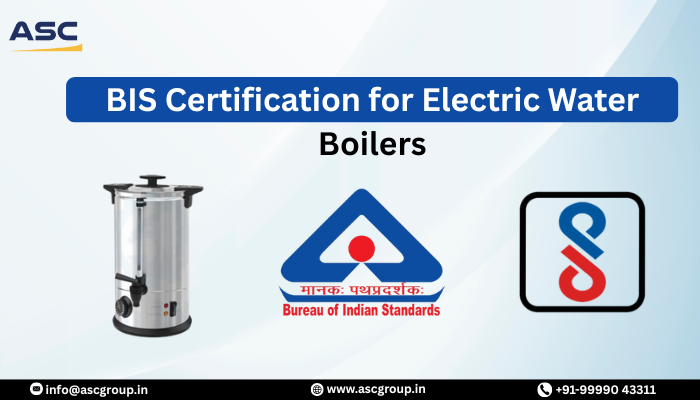
The market of India is expanding at a very fast pace and the demand for electric water boilers is also increasing in almost all hospitality sectors from household use to its use in hotels, restaurants and other commercial places. These electric water boiler devices are very helpful for individuals in their daily needs. This device is dealing with electricity, pressure and heating products that make it compulsory to have BIS certification to ensure consumers safety and establish themselves.
It is mandatory for manufacturers and importers to make their product as per the guidelines set by the government authorities under the specific Indian standards to legally run their businesses in the Indian market.
Applicable Indian Standard for Electric Water Boilers
Electric water boilers are regulated under:
- IS 302 (Part 2 / Section 21): Particular Requirements for Storage Water Heaters, read with
- IS 302 (Part 1): General Safety Requirements for Household and Similar Electrical Appliances
These standards are set by the government authorities to check the products technical, electrical and mechanical quality to assure the consumer safety.
Types of Electric Water Boilers Covered
The BIS standard applies to a wide range of electrical water-heating products, such as:
- Domestic water boilers
- Electric hot-water dispensing units
- Large-capacity electric kettles
- Commercial water heaters for food-service use
- Office and institutional electric water boilers
Any appliance intended to heat and store water using electrical energy falls within the scope of this standard.
Important Requirements set by the Bureau of Indian Standard
The BIS has set some important requirements that need to be fulfilled by all the manufacturers and importers to attain BIS certificate, such as:
1. Electrical Strength and Insulation
BIS requires boilers to:
- Prevent access to live electrical parts
- Use high-quality insulation
- Maintain proper earthing connections
- Include secure wiring layouts
These measures protect users from electrical shock.
2. Temperature Regulation and Overheat Protection
As boilers operate at high temperatures and store hot water, they must include:
- Automatic temperature controls
- Overheat protection devices
- Thermal cut-out units
- Reliable heating element design
These mechanisms prevent overheating and risk of fire.
3. Pressure and Structural Safety
Electric boilers must withstand internal water pressure and repeated thermal cycles.
BIS ensures:
- Strong tank construction
- Corrosion-resistant materials
- Safety valves to release excess pressure
4. Moisture and Leakage Protection
Since the appliance deals with water:
- Electrical parts must be sealed
- Tanks must resist leakage
- Outer casing should prevent moisture ingress
5. Safe Power Cord and Connection System
The appliance must have:
- Flexible, heat-resistant cables
- Effective strain relief
- Secure plug connections
This prevents damage during regular use.
6. Marking and User Information
Every electric water boiler must display:
- Voltage and wattage
- Manufacturer identification
- Model information
- Capacity
- Safety instructions
These details help ensure correct installation and safe handling.
BIS Certification Process for Electric Water Boilers
To obtain the ISI license, manufacturers and importers must follow:
- Submission of product samples for BIS laboratory testing
- Technical document review
- Factory audit to verify production quality
- Approval and issuance of BIS license
- Application of the ISI mark on each certified unit
Non-certified boilers cannot be marketed or sold in India.
Importance of BIS Certification
The product is in direct use by the consumers and it is dealing with electricity, heat and water that make this product more sensitive for users and it raises the need of quality check from authorities. BIS certification is important for:
- Safe operation
- Reduced risk of electrical accidents
- Longer product life
- Strong consumer trust
- Full legal compliance
How ASC Group Assists in BIS Certification
ASC Group supports companies by offering:
- Standard interpretation and compliance guidance
- Assistance in documentation and testing
- Coordination with labs and auditors
- Support with ISI marking and follow-up compliance
With expert handling, ASC Group ensures a smooth and efficient certification journey.
Conclusion
The government authorities make it mandatory to make their product align with IS 302 (Part 1) and IS 302 (Part 2 / Section 21) guidelines to assure consumer safety and legally enter the Indian market. It is mandatory for manufacturers and importers to have BIS certification to sell their product in the Indian market. A professional BIS consultant from ASC Group BIS Registration Consultant can help you attain your BIS certificate smoothly without any hectic process.

Leave a Reply