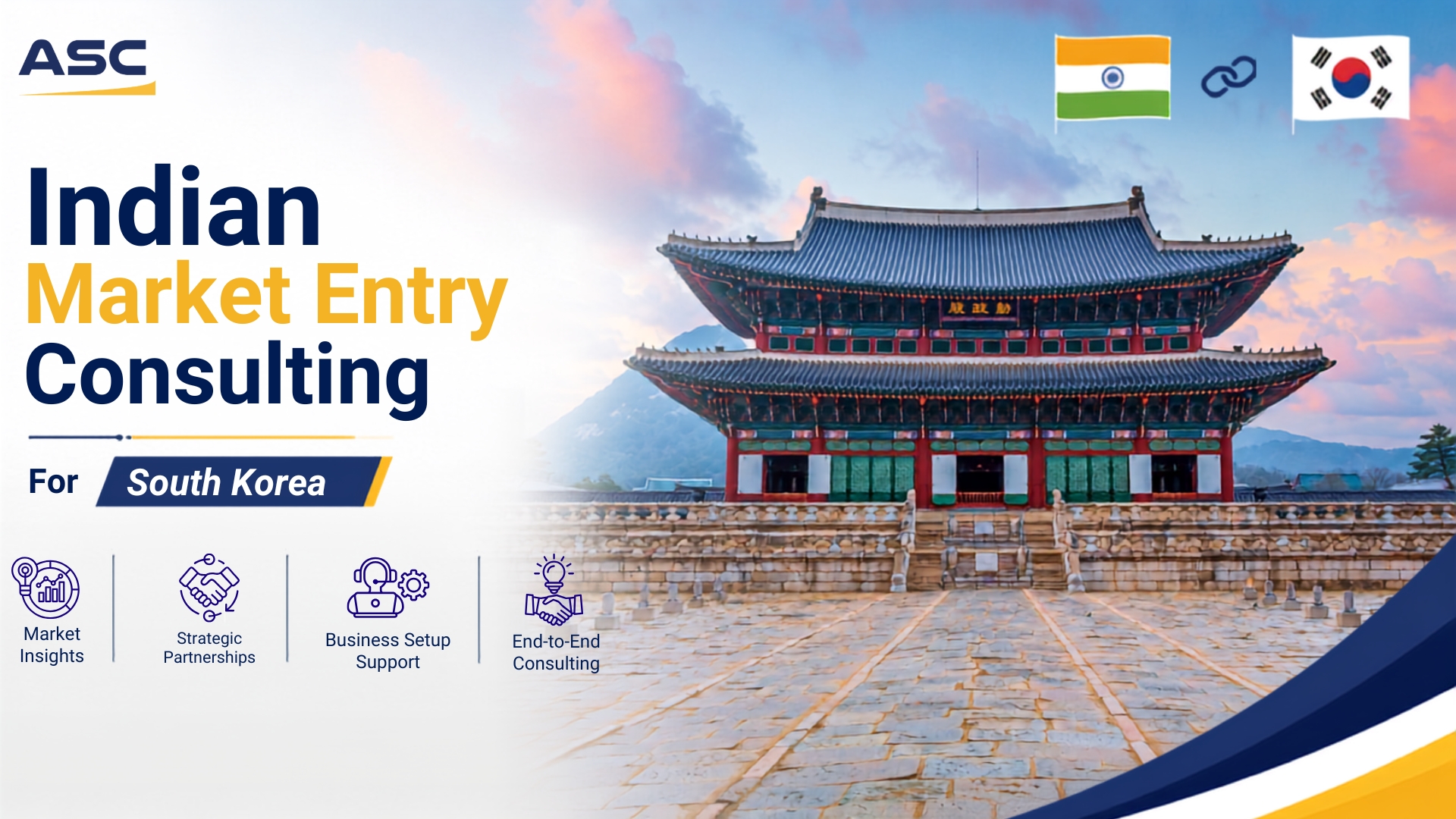
India Market Entry Consulting for South Korean
Why South Korean Companies Are Expanding Into India Now
South Korea's export-driven chaebol and mid-cap manufacturers have watched India emerge as one of the few remaining large markets where category leadership is still achievable — much as Korean electronics and automotive brands achieved in Southeast Asia and Eastern Europe over the past two decades. India's growing middle class, expanding manufacturing base, and China+1 supply chain realignment align directly with Korean industrial strategy, which has spent the past decade actively diversifying manufacturing footprint away from single-market concentration. For Korean beauty and consumer brands, India's rapidly Westernizing yet distinctly local beauty and skincare market represents a genuine growth frontier still open to new entrants.
The India-South Korea Business Relationship
India and South Korea operate under the Comprehensive Economic Partnership Agreement (CEPA), in force since 2010 and currently under further upgrade negotiations to expand tariff coverage and services access. The relationship is formalized as a Special Strategic Partnership, with regular summit-level engagement between the two governments. Korean conglomerates have been present in India for over two decades, with Samsung and Hyundai/Kia representing some of the most successful large-scale foreign manufacturing entries in Indian economic history. The Korea-India Cooperation Fund and sector-specific MoUs in electronics, shipbuilding, and defense manufacturing further support Korean industrial entry, while a growing Korean expatriate business community in Delhi-NCR and Chennai has built practical, ground-level familiarity that newer entrants can draw on.
Why South Korean Companies Choose India: Sector Drivers
- Electronics: India's electronics PLI scheme directly incentivizes Korean display, semiconductor-adjacent, and consumer electronics manufacturers to localize production.
- Automotive: India's position as a top-five global automobile market, combined with Hyundai and Kia's already-deep localization, creates strong supplier ecosystem opportunities for Korean auto component makers.
- Beauty & Consumer Brands: India's expanding premium and mass-beauty categories are increasingly receptive to K-beauty brand positioning, following patterns seen in Southeast Asia.
- Heavy Industries: India's infrastructure and shipbuilding demand aligns with Korean expertise in steel, shipbuilding, and heavy engineering.
Who Actually Enters India From South Korea
The dominant persona is the large Korean conglomerate (chaebol) affiliate establishing full-scale manufacturing operations, typically in electronics or automotive, following a multi-year phased localization plan. Alongside them, Korean auto component and electronics supplier mid-caps establish India operations specifically to remain within the supply chain of an already-present Korean OEM anchor client. A distinct and fast-growing third persona is the Korean beauty and consumer brand entering through distribution partnerships or direct e-commerce-led market entry, requiring far less capital commitment than manufacturing-led entrants.
Strategic Benefits for South Korean Companies Entering India
For Korean electronics manufacturers, PLI-linked incentives combined with proximity to Samsung's existing India manufacturing ecosystem create supplier-cluster advantages difficult to replicate through direct export alone. For Korean auto component makers, the deep localization already achieved by Hyundai and Kia provides an existing anchor-client relationship that substantially de-risks new supplier entry. For Korean beauty brands, India's underpenetrated premium skincare category, combined with growing e-commerce and D2C infrastructure, allows for lower-capital market testing before committing to full retail infrastructure.
Industry-Specific Opportunities
Beyond electronics, automotive, beauty, and heavy industries, Korean shipbuilding and marine engineering firms are finding opportunity in India's naval modernization and commercial shipbuilding capacity expansion, an area where Korean technical expertise remains globally dominant. Korean battery and EV component manufacturers are also increasingly evaluating India capacity, directly aligned with both countries' parallel EV supply chain diversification strategies.
Country-Specific Challenges for South Korean Companies
Korean companies most often encounter friction in three areas: hierarchical decision-making pace, since Korean corporate structures often require multiple levels of internal sign-off (similar in spirit to Japanese ringi-sho but structurally distinct) that must be planned against India's faster-moving commercial negotiation pace; labor relations differences, since India's labor law and union environment operates on different statutory footing than Korea's, requiring dedicated HR and industrial relations expertise rather than direct policy transplant; and brand localization for consumer entrants, since K-beauty and Korean consumer positioning requires meaningful adaptation to Indian skin-tone ranges, climate considerations, and price-tier expectations rather than direct product-line replication. A further challenge specific to heavy industry and shipbuilding entrants is India's public-procurement-heavy demand structure for infrastructure and defense-linked projects, which requires building government-tender capability and local partnership networks distinct from the largely private-sector B2B relationships Korean heavy industry firms typically rely on at home.
The India Market Entry Roadmap for South Korean Companies
- Entity and supplier-cluster strategy — Standalone subsidiary vs. supplier-ecosystem entry near existing Korean OEM anchor clients.
- CEPA utilization mapping — Structuring import/export flows to capture available tariff reductions, with attention to ongoing CEPA upgrade negotiations.
- Incorporation and site selection — Company registration alongside plant location decisions near Chennai, Pune, or NCR Korean-linked industrial clusters.
- Product localization — Adapting product specifications, particularly for consumer and beauty brands, to Indian market conditions.
- Workforce and industrial relations setup — Compliant hiring, labor law adherence, and India-specific industrial relations management.
- Ongoing compliance — GST, transfer pricing for Korea-India intercompany transactions, and annual statutory filings.
How ASC Group Supports South Korean Companies
We work with Korean head-office leadership and India-based country managers to bridge hierarchical Korean approval structures with India's faster commercial pace, coordinating directly with existing Korean industrial clusters and providing the structured, milestone-based reporting format Korean corporate governance expects at each stage of approval. For chaebol-affiliated entrants specifically, we align our documentation cadence with the multi-level internal review common across Korean corporate hierarchies, ensuring each approval stage receives the level of formal detail required to move efficiently through headquarters sign-off without repeated re-submission.
Real Business Scenario
A Korean auto component manufacturer needed to establish an India plant to remain within an existing Hyundai India supply chain relationship as the OEM increased local sourcing requirements. We structured a wholly owned subsidiary near the existing Chennai automotive cluster, sequenced factory licensing and environmental clearance in parallel, and built a transfer pricing framework aligned with the parent company's global intercompany policy — meeting the OEM's localization deadline.
Case Study Snapshot: K-Beauty Brand Market Entry
Objective: A Korean beauty brand wanted to test the Indian market without committing to full retail infrastructure. Challenge: The brand's existing product formulations were optimized for Korean and Southeast Asian climate and skin-tone profiles, not India's broader range. Strategy: We structured a distribution-led entity with e-commerce-first go-to-market, alongside a phased product reformulation roadmap based on India-specific consumer testing. Outcome: The brand launched with a right-sized India product range and minimal upfront capital exposure.
South Korean Companies Already Succeeding in India
Samsung operates one of its largest global manufacturing facilities in India, alongside a significant R&D and design presence — widely regarded as one of the most successful foreign manufacturing entries in Indian history. LG has built deep India manufacturing and distribution infrastructure across consumer electronics and appliances. Hyundai and Kia together represent one of the most complete automotive localization stories of any foreign OEM in India, with Hyundai ranking among India's top automobile manufacturers by volume. Each demonstrates that full-scale Korean manufacturing commitment, backed by patient multi-year localization, consistently outperforms partial or trading-led entry models in the Indian market.
Frequently Asked Questions
What is the current status of India-South Korea CEPA?
CEPA has been in force since 2010, with both governments engaged in upgrade negotiations to expand tariff coverage and services access further.
Do Korean companies need a local partner to enter India?
Not typically under the automatic FDI route for most electronics, automotive component, and consumer sectors, though supplier-cluster entries often benefit from proximity to existing Korean OEM anchors.
How significant is Samsung and Hyundai's presence for new Korean entrants?
Very significant — their supplier ecosystems, government relationships, and market credibility substantially de-risk new Korean entrants in electronics and automotive component sectors specifically.
What is the biggest localization mistake Korean consumer brands make in India?
Assuming Southeast Asian K-beauty product-market fit transfers directly to India without adapting for skin-tone range, climate, and price-tier positioning.