Is BIS Certification Required for Floor Treatment Machines in India?
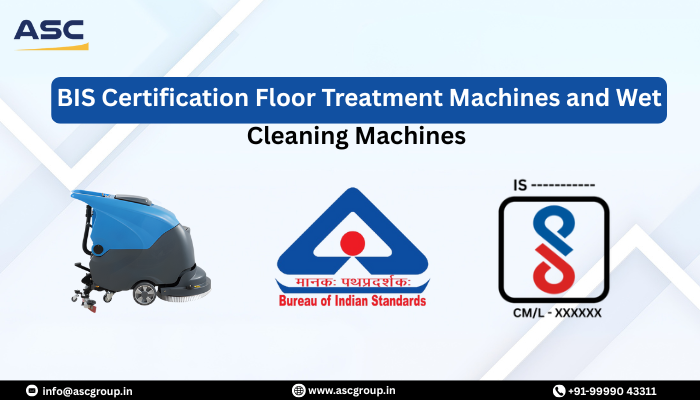
Floor treatment machines such as scrubbers, polishers, burnishers, and surface cleaning systems are widely used in commercial buildings, industrial facilities, airports, hospitals, and large residential complexes. Before manufacturing, importing, or distributing such equipment in India, businesses must determine whether the product falls under mandatory compliance requirements issued by the Bureau of Indian Standards (BIS Certification).
Regulatory applicability depends on product classification, electrical configuration, operational design, and coverage under notified Quality Control Orders (QCOs).
Regulatory Framework for Electrical and Mechanical Equipment
Equipment used for commercial or industrial maintenance may be regulated under:
-
BIS Act, 2016
-
Relevant Quality Control Orders (QCOs)
-
Applicable Indian Standards (IS codes)
-
Electrical safety and performance standards
If a product category is notified under a mandatory standard, compliance approval must be obtained prior to sale or import.
Do Floor Treatment Machines Require BIS Approval?
Applicability depends on several technical and regulatory factors, including:
-
Whether the machine is electrically operated
-
Rated voltage and power capacity
-
Industrial vs household classification
-
Motor configuration and safety features
-
Coverage under specific IS standards
Some electrically operated cleaning and surface treatment machines may require certification depending on how they are classified under current notifications.
Product Classification Considerations
When evaluating compliance requirements, businesses typically assess:
-
Type of machine (scrubber, polisher, buffer, burnisher)
-
Power source (corded electric, battery-operated, three-phase supply)
-
Intended commercial or industrial use
-
Safety mechanisms such as overload protection and insulation
-
Construction materials and mechanical design
Correct identification of the applicable Indian Standard is essential before market entry.
Compliance Pathway (If Covered Under Mandatory Standards)
If certification is required, compliance may involve:
-
Identification of the relevant Indian Standard
-
Testing at a BIS-recognized laboratory
-
Preparation of technical documentation
-
Application submission under the prescribed route
-
Grant of license or registration
Inspection requirements vary depending on the applicable certification scheme.
Labeling and Marking Requirements
Where approval is granted, machines must:
-
Display the prescribed BIS standard mark (if applicable)
-
Mention license or registration number
-
Ensure compliant labeling on equipment and packaging
Improper marking may lead to enforcement action under regulatory provisions.
Import and Distribution Considerations
Importers and distributors of floor treatment machines should verify:
-
Certification validity at the time of shipment
-
Electrical compatibility with Indian grid standards
-
Technical specification alignment with declared standards
-
Customs documentation accuracy
-
Brand authorization documentation (if applicable)
Non-compliance may result in customs detention or penalties.
Common Compliance Challenges
-
Misclassification between household cleaning appliances and industrial equipment
-
Incorrect IS standard mapping
-
Incomplete technical documentation
-
Power rating inconsistencies
-
Failure to monitor regulatory amendments
A structured regulatory review before product launch reduces compliance risk.
Conclusion
Before introducing floor treatment machines into the Indian market, manufacturers and importers should conduct a regulatory applicability assessment. Accurate classification under the relevant Indian Standard and alignment with notified compliance requirements help ensure smooth market entry and reduce regulatory exposure.
FREQUENTLY ASKED QUESTIONS
Not necessarily. Applicability depends on whether the product category is notified under mandatory standards.
It depends on classification under relevant electrical appliance or industrial equipment standards.
Inspection requirements vary depending on the certification scheme applicable to the product.
If the product falls under a notified QCO, approval is required before import into India.
Leave a Reply